

Icelandic Red Algae For Joint Pain Relief – What You Should Know
Could Icelandic Red Algae for Joint Pain Relief be the next popular health supplement to find its way into our kitchen cupboards? This is something I’ve been recently looking into.
Mostly, because of what this type of seaweed can apparently do for pains in the knees, ankles, wrists, elbows, back and neck.
Since running this website I have looked into a number of different supplements for joint pain. For example, Glucosamine and Chondroitin, DMSO and Turmeric just to name a few. All of these I have looked at in previous posts and product reviews, but how does Icelandic Red Algae compare?
This is a good question and one factor that does make me curious about the effectiveness of this sea plant is that Iceland has been found in studies to be one of the healthiest countries in the world.
This is widely believed to be because of the mineral-rich volcanic soil and the superior nutritional benefits this has for things like Icelandic Vegetables and Fish.
Why? It can only be surmised by the incredible health effects such things have had on people that have visited the country. Plus the observations of the Icelandic people that are said to rank as the 3rd most healthy nation in the world.
Which, is exactly what I will be delving into today. How all this is related and why Icelandic Red Algae for Inflammation and Pain Relief might just be the solution for those suffering with unbearable joint pain.
Can this strange underwater plant really make the difference?
This is certainly quite a fascinating topic anyway and actually for this blog post I definitely think this warrants further investigation.
So without further ado let’s begin with looking at what this remarkable underwater plant can really do…
What You Should Know About Icelandic Red Algae?

Before we even begin talking about Icelandic Red Algae – what should be clear to many people is that joint pain and especially arthritis is a very common health issue. It is said that around 350 million people globally and as many as 1 in every 4 in the USA have some form of arthritis or Inflammatory Joint Pain.
Inflammation is the most common cause of Joint pain – an effect usually caused by the body’s natural immune response.
Bones, ligaments, tendons, muscles and cartilage can all be affected by inflammation.
For this, finding a means of bringing this condition under control is very often the main solution for the treatment and relief of joint pain.
This is because once affected by Inflammation this can attack the joints and surrounding areas. Protective tissue that surrounds the joints can as a result becomes damaged – which can then lead to infection, swelling and further problems.
~Which, brings us to Icelandic Red Algae as a possible treatment – SKIP AHEAD to see my top recommended product [HERE]
Using Icelandic Red Algae for Joint Pain Relief?

Red algae (Rhodophyta) are the most common type of benthic algae found in the Icelandic Sea. They are often not large or conspicuous and belong to a very distinct, primitive group found almost exclusively in the ocean connected to the Icelandic Seas.
The main benefits of Icelandic red algae is its ability to help treat several different health conditions – not just joint pain.
For example;
- Poor Circulation,
- Low (or high) Blood Sugar Levels
- Fighting back against bad (LDL) cholesterol – amongst many other things
These health benefits can largely be attributed to the high Iodine content found in all types of Seaweed. Something which is known for its positive effect on the Thyroid gland and hormones. Very important for how the body metabolizes energy – but definitely Icelandic Red Algae is on another level here.
Much because of the abundance of minerals this plant absorbs from the Icelandic Seawater. Indeed, something like 70+ different Trace Minerals can be found contained within the structure of Icelandic Red Algae.
Certainly, compared to other underwater vegetation (which is nowhere near as nutrient-rich) Icelandic Red Algae gives us a lot of food for thought, but how effective really is this?
What Does Icelandic Red Algae Do for The Body?
I’ve discussed some of the health benefits of Icelandic Red Algae above already but perhaps one key thing to note about this plant is the high levels of antioxidants that this contains.
These include;
- Polyphenols,
- Vitamins and
- Polyunsaturated fatty acid contents.
And not just these but also non-protein based amino acids that separately are known for many of their own different health benefits.
These are not limited to;
- Lowering Unhealthy Cholesterol Levels,
- Improving Skin Health,
- Thyroid Function,
- Balancing Blood Sugar Levels,
- Better Gut Health,
- Strengthening the Immune System.
And this is all besides the Inflammation relief and joint pain benefits.
This plant is just generally very nutritious and healthy but let’s circle back to the main discussion.
How Much Can Icelandic Red Algae Help With Joint Pain?

This is really the big question. Icelandic Red Algae certainly sounds impressive from a nutritional point of view, but can it actually help if you suffer from aching, stiff or painful joints?
There is some interesting research here, although I think it’s important to really try and understand what this actually is.
For example, “Icelandic red algae” as a general food or supplement I have not found specific studies for, but for Aquamin, a mineral-rich ingredient derived from calcified red algae (Lithothamnion species) there has been studies with early results looking quite promising.
Aquamin naturally provides calcium and magnesium along with a range of trace minerals. This makes it particularly interesting for bone health, but researchers have also investigated whether it could benefit people suffering from osteoarthritis – and this is quite Interesting as well.
What Does the Research Actually Say?
One randomized controlled pilot study involved 70 people with moderate to severe osteoarthritis of the knee.
Participants were given either:
- Aquamin
- Glucosamine sulphate
- Aquamin + Glucosamine
- A placebo
The study lasted for 12 weeks, with 50 participants completing the trial.
Interestingly, both the Aquamin and Glucosamine groups experienced improvements in osteoarthritis symptoms during the study. The Aquamin group also improved its six-minute walking distance by around 7%.
However, there is an important catch.
The researchers found differences in pain and stiffness between the groups before treatment even began. Because of this, they specifically warned that the results should be interpreted with caution.
So while the results were encouraging, this certainly wasn’t enough to prove that red algae is an effective treatment for osteoarthritis.
Although…
A second small study produced similarly interesting results.
This time researchers investigated Aquamin in people with moderate to severe knee osteoarthritis while they reduced their use of NSAID pain medication.
Participants taking Aquamin showed improvements in walking distance and knee range of motion compared with placebo.
However, there was no significant difference in the main WOMAC pain scores between Aquamin and placebo.
Again, the researchers concluded that the results were preliminary and that more research was needed.
What About Red Algae vs Glucosamine?
This is something I discussed in the original version of this article, and there has since been some more interesting research.
A 2020 randomized crossover pilot trial compared glucosamine with a formula containing Lithothamnion red algae, seawater-derived magnesium and pine bark extract in 30 people with symptomatic knee osteoarthritis.
The mineral-rich algae formula produced improvements in pain and some measures of physical function and was associated with considerably lower use of pain medication compared with glucosamine.
This certainly caught my attention.
However, there are two important things to remember.
Firstly, there were only 30 participants, so this was still a very small study.
Secondly, the supplement contained magnesium and pine bark extract as well as red algae. We therefore can’t say that red algae alone was responsible for the results.
This is quite different from saying, as you might see on some supplement websites, that “Icelandic red algae has been clinically proven to beat glucosamine.”
The research simply isn’t strong enough to make that claim yet.
So, Does Icelandic Red Algae Work for Joint Pain?
I think the fairest answer at the moment is possibly, but we need more evidence.
There is some genuine human research suggesting that mineral-rich red algae supplements could support mobility, stiffness and other symptoms associated with knee osteoarthritis.
That’s encouraging.
But these have generally been small pilot studies rather than large, long-term clinical trials. We also shouldn’t assume that results obtained using Aquamin or combination formulas will apply to every red algae supplement on the market.
For me, the more convincing reason to be interested in Icelandic red algae is actually its mineral content.
Calcium, magnesium and other trace minerals all have important roles within the body, and calcium in particular is essential for maintaining normal bones.
That brings us to another part of this topic which I think is worth separating from joint pain itself…
Icelandic Red Algae and Bone Health
One mistake I made in the older version of this article was treating joint health and bone health almost as if they were the same thing.
They’re not.
Joint pain can have many different causes, including osteoarthritis, injury, inflammation and problems involving cartilage, tendons or other tissues. Simply consuming more calcium isn’t therefore going to make every type of joint pain disappear.
However, calcium remains extremely important for maintaining healthy bones.
This is one area where mineral-rich red algae becomes particularly interesting.
Calcified red algae naturally accumulates minerals from seawater during its lifetime. Supplements made from species such as Lithothamnion therefore provide calcium alongside magnesium and smaller amounts of numerous trace minerals.
There has even been research investigating how calcium derived from Lithothamnion is absorbed and metabolized compared with conventional calcium carbonate.
This doesn’t mean red algae calcium is automatically “better” or that everybody needs to supplement with it. But it does make it an interesting alternative source of calcium, particularly for people looking for a marine-derived multimineral supplement.
Where Does Vitamin D Fit Into This?
Vitamin D deserves mentioning here because it helps the body absorb calcium and is important for maintaining normal bones.
This is why you’ll often see calcium supplements combined with Vitamin D rather than calcium being sold completely on its own.
The important distinction, though, is that Vitamin D doesn’t somehow activate Icelandic red algae specifically. It’s simply part of the body’s normal calcium regulation and bone-health system.
Likewise, magnesium also contributes to normal bone health and has numerous other functions throughout the body.
So rather than looking at Icelandic red algae as some sort of miracle joint-pain remedy, I think it makes much more sense to look at it for what it actually is:
A naturally occurring source of calcium, magnesium and trace minerals that may have some interesting benefits for bone and joint health.
There is enough early research here to make it worth investigating, but not enough for me to tell you that taking Icelandic red algae is going to make your joint pain disappear.
How Does Icelandic Red Algae Compare With Other Joint Supplements?
Of course, Icelandic red algae is far from the only supplement people use for joint health.
Glucosamine, turmeric, collagen and magnesium are all popular choices, but they don’t necessarily work in the same way. This is something worth considering before deciding which supplement makes the most sense for you.
Here is a quick comparison:
| Supplement | Why People Take It | Main Area of Interest |
|---|---|---|
| Icelandic Red Algae | Naturally provides calcium, magnesium and trace minerals | Bone and mineral support |
| Glucosamine | Commonly used by people with osteoarthritis | Cartilage and joint function |
| Turmeric/Curcumin | Curcumin has been studied for its anti-inflammatory properties | Inflammation and joint discomfort |
| Collagen | Provides amino acids used within connective tissues | Cartilage and connective tissue support |
| Magnesium | Essential mineral involved in hundreds of processes within the body | Muscle, nerve and bone health |
As you can see, choosing between these isn’t necessarily a case of finding one supplement that is “better” than all the others.
They are quite different.
Icelandic Red Algae vs Turmeric
Turmeric is probably one of the most obvious comparisons because it is widely used by people looking for natural ways to support their joints.
Its main active compounds are known as curcuminoids, with curcumin being the one that receives most of the attention.
Curcumin has been extensively studied for its anti-inflammatory properties, and there is some evidence suggesting supplementation may help reduce pain and improve physical function in people with knee osteoarthritis.
This gives turmeric a somewhat different purpose from red algae.
With Icelandic red algae, I’m more interested in the calcium, magnesium and trace minerals it provides. With turmeric, the main attraction is curcumin and its potential effect on inflammatory processes.
So if inflammation and discomfort are your main concerns, turmeric may be something worth investigating.
If you’re particularly interested in mineral intake and maintaining healthy bones alongside your joints, red algae arguably fits that purpose better.
And there’s no reason to think of this as an either/or situation. Some joint-health formulas combine minerals with other ingredients aimed at inflammation and connective tissue support.
What About Glucosamine?
We’ve already looked at glucosamine in the research above.
Unlike red algae, glucosamine isn’t primarily taken as a source of minerals. It occurs naturally within the body and plays a role in compounds found within cartilage.
This is why glucosamine supplements have traditionally been marketed towards people with osteoarthritis and age-related joint problems.
However, research into glucosamine has produced mixed results, and it shouldn’t be viewed as something that can simply “rebuild” damaged cartilage.
The small studies we looked at earlier also make red algae interesting as an alternative, although there isn’t enough evidence yet to say that red algae is superior to glucosamine.
What About Collagen?
Collagen is another interesting option and one that probably makes more sense to include here than CBD.
Collagen is a major structural protein found throughout the body, including in bones, tendons, ligaments and cartilage.
Some research has investigated collagen peptides and specific forms of collagen for joint discomfort and osteoarthritis, although once again results vary depending on the product and study.
The biggest difference is nutritional.
Red algae primarily supplies minerals, whereas collagen provides protein-derived peptides and amino acids.
This means they aren’t really competing to do exactly the same job.
And What About Magnesium?
Magnesium deserves a special mention because Icelandic red algae naturally contains it.
Magnesium contributes to the maintenance of normal bones as well as normal muscle and nervous-system function.
This is one reason I find mineral-rich red algae more interesting than simply looking at it as another calcium supplement.
You’re not getting calcium completely in isolation.
However, the actual amounts of magnesium and other minerals can differ considerably between products, so it’s always worth checking the supplement facts rather than assuming every red algae product provides the same thing.
Which Is Best for Joint Health?
I don’t think there is one answer that applies to everybody.
If you’re looking primarily at bone and mineral support, a mineral-rich red algae supplement could be interesting.
If inflammation and joint discomfort are your biggest concerns, curcumin is probably more relevant to investigate.
Glucosamine and collagen are different again, with both being studied specifically in relation to cartilage and joint function.
More importantly, persistent joint pain shouldn’t automatically be treated as a nutritional problem.
Osteoarthritis, rheumatoid arthritis, gout, injuries, tendon problems and numerous other conditions can all cause joint pain, and supplements aren’t substitutes for finding out what is actually causing the problem.
This is why I prefer to look at Icelandic red algae as one potentially useful joint and bone-supporting supplement, rather than presenting it as a cure for joint pain.
Who Might Benefit From Icelandic Red Algae?
So who might actually want to consider taking Icelandic red algae?
Based on what we’ve looked at so far, I think it makes the most sense for people who are interested in supporting their mineral intake and maintaining healthy bones, rather than anyone expecting it to work like a fast-acting painkiller.
This could include:
- Older adults concerned about bone health: Maintaining bone mineral density becomes increasingly important as we get older, particularly because the risk of osteoporosis and fractures increases with age.
- People looking for an alternative source of calcium: Red algae provides a marine-derived source of calcium along with magnesium and various trace minerals.
- People interested in broader bone and joint support: Although the research into joint pain is still limited, the combination of calcium, magnesium and trace minerals makes red algae an interesting ingredient for supporting the musculoskeletal system.
- People who don’t get enough calcium from their diet: Someone who consumes very little dairy or other calcium-rich foods may be interested in alternative sources. However, supplements shouldn’t automatically be the first option if dietary intake can be improved.
- People already researching supplements for osteoarthritis: The early Aquamin research we’ve looked at makes red algae interesting in this area, but I’d still regard it as a complementary option rather than a proven treatment.
One important point here is that having joint pain doesn’t necessarily mean you need more calcium.
Joint pain can have many different causes, and taking additional calcium isn’t going to correct conditions such as an injury, gout or rheumatoid arthritis.
This is why I’d be particularly cautious about any supplement company suggesting that red algae calcium can “fix” joint pain simply because calcium is good for your bones.
There is a much bigger picture to consider.
Who Should Be Careful With Red Algae Supplements?
Just because something comes from a natural source doesn’t automatically mean that everybody needs it or that taking more is always better.
This is particularly relevant with calcium.
Getting enough calcium is important, but excessive supplemental calcium isn’t necessarily beneficial. You also need to consider how much you’re already getting from food and other supplements.
For this reason, I’d recommend being particularly cautious if you:
- Already take a calcium supplement — check the combined amount you’re getting rather than accidentally doubling up.
- Have kidney problems or a history of kidney stones — calcium and mineral supplementation may require more careful consideration.
- Take prescription medication — calcium and magnesium supplements can interfere with the absorption of certain medicines when taken at the same time.
- Have been advised to restrict your calcium or mineral intake — speak to your doctor before adding another mineral supplement.
- Are pregnant or breastfeeding — it’s sensible to discuss supplements with a healthcare professional, particularly products containing several different minerals.
You should also check exactly what you’re buying.
“Icelandic red algae” can be used quite loosely in supplement marketing, and different products may contain different species, mineral concentrations and additional ingredients.
Some formulas, for example, add Vitamin D3 and Vitamin K2. Others may contain nothing more than a red-algae-derived mineral complex.
This is another reason why I wouldn’t choose a supplement based purely on the words “Icelandic Red Algae” on the front of the bottle.
What About Iodine?
There’s another point worth clearing up from the original version of this article.
Earlier, I mentioned iodine as one of the reasons seaweed may offer health benefits. However, we shouldn’t assume that every red algae calcium supplement is automatically a significant source of iodine.
The mineral composition depends on the species, where it is harvested and how the ingredient is processed.
If iodine is one of the reasons you’re considering a particular product, check the actual nutrition or supplement label rather than assuming it’s there.
This is particularly important for people with thyroid conditions, where deliberately increasing iodine intake without medical advice may not be appropriate.
Check the Label Before You Buy
Ultimately, this is probably the simplest advice I can give.
Look beyond the marketing and check:
- How much calcium does it provide?
- How much magnesium?
- What other minerals are listed?
- Does it contain Vitamin D or K2?
- What form of red algae is being used?
- And what is the recommended daily serving?
I’d also look for a manufacturer that provides clear ingredient information and preferably some form of independent quality or contaminant testing.
Red algae can be an interesting source of minerals, but the quality of the finished supplement matters just as much as the ingredient on the front of the bottle.
How to Choose a Good Red Algae Supplement
If you decide Icelandic red algae is something you’d like to try, choosing a good supplement isn’t quite as simple as finding the cheapest bottle online.
There can be considerable differences between products, particularly in the amount of calcium and magnesium they provide and whether other nutrients have been added.
Here are a few things I would look for.
1. Check the Source of the Red Algae
First, find out exactly what type of red algae the supplement contains.
Many of the mineral supplements you’ll come across use calcified red algae from the Lithothamnion genus. You may also see branded mineral ingredients such as Aquamin, which is derived from calcified red marine algae.
Ideally, the manufacturer should clearly tell you what ingredient is being used rather than simply putting “Red Algae Calcium” on the front of the bottle.
2. Look at How Much Calcium You’re Actually Getting
Don’t assume that a bigger dose of red algae automatically means you’re getting more calcium.
Check the supplement facts and look at the amount of elemental calcium provided per serving.
This is particularly important if you already consume plenty of calcium-rich foods or take another supplement containing calcium.
More isn’t necessarily better.
3. Check the Magnesium Content
One of the things that originally attracted me to Icelandic red algae was that it isn’t necessarily just a source of calcium.
Calcified red algae can also provide magnesium along with smaller amounts of other minerals.
However, the amount matters.
A product might advertise magnesium as one of its benefits while providing only a relatively small quantity. Again, the supplement label should tell you what you’re actually getting.
4. Look for Vitamin D – But Don’t Assume You Need It
You’ll find some red algae calcium supplements that also contain Vitamin D3.
This makes sense because Vitamin D helps the body absorb calcium and contributes to the maintenance of normal bones.
However, this doesn’t automatically make a supplement better.
You may already take Vitamin D separately or get enough from another supplement, so it’s worth looking at your overall intake rather than doubling up unnecessarily.
5. Vitamin K2 Can Be Another Addition
Some bone-health formulas also combine calcium and Vitamin D with Vitamin K2.
Vitamin K contributes to the maintenance of normal bones, which explains why it often appears in these types of supplements.
Again, though, check the amount and form rather than assuming its presence automatically makes one product superior to another.
And if you take certain medications, particularly anticoagulants such as warfarin, Vitamin K supplements are something you should discuss with your doctor or pharmacist.
6. Look for Independent Quality Testing
This is something I’ve become much more conscious of when reviewing supplements.
Seaweed and other marine ingredients can accumulate substances from the environment they grow in. For this reason, I’d prefer a company that provides information about quality control and contaminant testing, including testing for heavy metals where appropriate.
A vague claim such as “premium quality” doesn’t really tell you very much.
I’d rather see a company explain where its ingredients come from, how they’re processed and what testing takes place before the finished supplement reaches the customer.
7. Don’t Get Distracted by Huge Numbers of “Trace Minerals”
You’ll often see red algae products advertised as containing 70+ trace minerals.
That sounds impressive, and the mineral diversity of calcified red algae is certainly one of the reasons these supplements have attracted attention.
But there’s an important distinction between a mineral being detectable and it being present in an amount significant enough to provide a meaningful nutritional benefit.
For me, calcium and magnesium are much more useful numbers to look at because manufacturers can tell you exactly how much you’re getting.
8. Consider Value Rather Than Just Price
Finally, I wouldn’t automatically buy the cheapest option.
Instead, compare:
- The number of servings per bottle
- Calcium per serving
- Magnesium per serving
- Added Vitamin D or K2
- Ingredient sourcing
- Independent testing
- Other unnecessary fillers or additives
- The manufacturer’s reputation
A £15 supplement isn’t necessarily better value than a £30 product if you need twice as many capsules to get a comparable serving.
Likewise, an expensive supplement isn’t automatically better simply because the manufacturer has a convincing website.
The supplement facts label is usually a much better place to start.
Where Can You Buy Icelandic Red Algae?
Red algae mineral supplements are now available from numerous supplement companies and online retailers, so they’re considerably easier to find than they once were.
Rather than recommending a product purely because it’s available on Amazon, eBay or another marketplace, I’d focus first on the points above.
Look at the source of the algae, the actual amounts of calcium and magnesium, any additional ingredients and whether the manufacturer provides adequate quality-testing information.
Once you’ve done that, you can make a much more meaningful comparison between products.
There is, however, one particular red algae calcium supplement that I originally featured quite heavily in this article — GenF20 Icelandic Red Algae Calcium.
So is this product still worth considering?
Let’s take another look.
What Is GenF20 Red Algae Calcium?
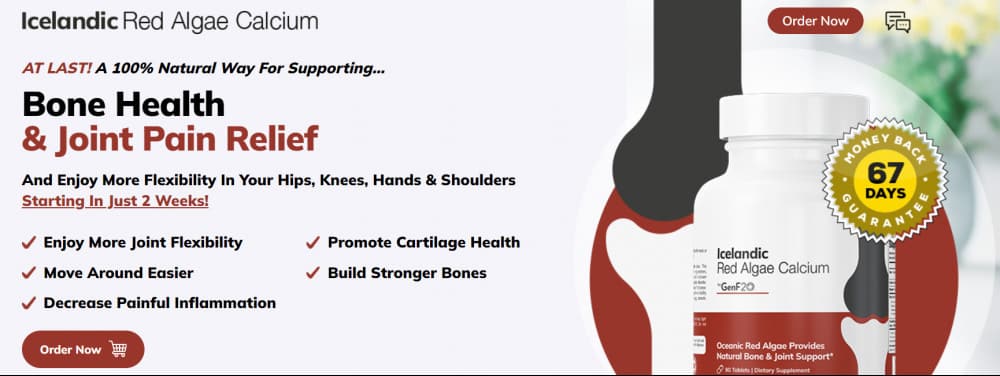
GenF20 Icelandic Red Algae Calcium Review
One product I featured quite heavily in the original version of this article was GenF20 Icelandic Red Algae Calcium, made by Leading Edge Health.
The good news is that this product is still available, and I still think it’s an interesting formula.
However, looking at it again now, I think it’s more useful to judge the product based on what’s actually inside it rather than some of the bigger claims made in the marketing.
What’s Actually in GenF20 Red Algae Calcium?
GenF20 isn’t simply just any ordinary Icelandic red algae supplement.
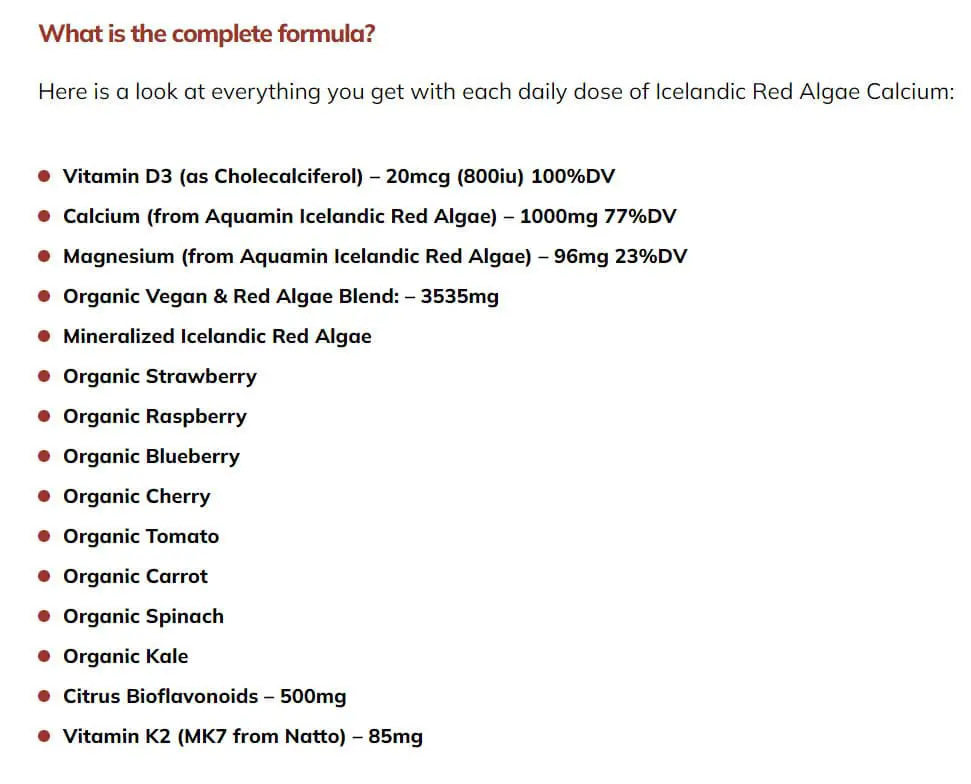
It’s a broader bone and joint-support formula combining red algae-derived minerals with several additional nutrients.
These include:
Red Algae Calcium
This is obviously the star ingredient and the main reason we’re discussing the product.
The calcium is obtained from mineral-rich red algae rather than conventional sources such as calcium carbonate. As we’ve already discussed, calcified red algae also naturally contains magnesium and numerous trace minerals.
Magnesium
Magnesium contributes to the maintenance of normal bones as well as normal muscle and nervous-system function.
I particularly like seeing calcium and magnesium together rather than a formula concentrating entirely on calcium.
Vitamin D3
Vitamin D contributes to the maintenance of normal bones and helps with the normal absorption and utilization of calcium.
One thing worth knowing, however, is that the Vitamin D3 used in this formula is cholecalciferol derived from lanolin, so despite the plant-based red algae calcium, the complete formula isn’t vegan.
Vitamin K2
Vitamin K also contributes to the maintenance of normal bones.
GenF20 uses Vitamin K2 in the MK-7 form, which is commonly found in supplements designed specifically around bone health.
Citrus Bioflavonoids
The formula also contains citrus bioflavonoids. These are naturally occurring plant compounds found in citrus fruits such as oranges and lemons.
Organic Fruit and Vegetable Blend
Finally, GenF20 includes a blend containing strawberry, raspberry, blueberry, cherry, tomato, carrot, spinach and kale.
I wouldn’t buy the supplement specifically because of this blend, and personally I think the calcium, magnesium, Vitamin D and Vitamin K are far more relevant.
Nevertheless, it’s another source of plant compounds within the overall formula.
What I Like About GenF20 Red Algae Calcium
The biggest positive for me is that the formula makes sense from a bone-health perspective.
Instead of simply giving you a large dose of calcium, it combines red algae-derived calcium with magnesium, Vitamin D3 and Vitamin K2.
These nutrients have established roles in maintaining normal bones, which gives the formula a much clearer rationale than supplements built around dozens of exotic ingredients with little explanation for why they’re there.
I also like the fact that Leading Edge Health has been around for many years rather than appearing to be another anonymous supplement company selling a single product.
And, of course, the red algae itself is what makes the product particularly interesting given the research we’ve already looked at earlier in this article.
What Don’t I Like?
There are a few things I’d still consider before buying it.
Firstly, it’s not vegan.
This is quite easy to miss because the main calcium ingredient comes from red algae. However, the Vitamin D3 is derived from lanolin, which comes from sheep’s wool.
Secondly, the 67-day money-back guarantee is reasonable, but I’ve reviewed other supplement companies offering considerably longer guarantees.
Then there is the price.
At $59.95 for a one-month supply, this certainly isn’t a cheap calcium supplement.
You’re paying for a more comprehensive formula and the red algae-derived mineral source, so whether that’s worth the additional cost will depend on what you’re actually looking for.
I’d also like to see supplement companies generally make testing, sourcing and complete label information as easy as possible for customers to find. With any mineral supplement, these are details I now pay much more attention to than I did when I originally wrote this article.
Does GenF20 Red Algae Calcium Work?
This is where I think we need to separate the ingredients from the marketing.
There are good reasons to include calcium, magnesium, Vitamin D and Vitamin K in a supplement designed to support normal bones.
There is also some interesting preliminary research involving red algae-derived multimineral ingredients, as we’ve already discussed.
What I wouldn’t do is take this as proof that GenF20 itself will eliminate joint pain or rebuild damaged joints.
That’s a much bigger claim.
Your results could also depend on why your joints hurt in the first place and whether you’re actually lacking any of the nutrients supplied by the formula.
So rather than thinking of GenF20 as a “joint pain cure”, I think it’s much more reasonable to describe it as a mineral and bone-support supplement that may also be of interest to people concerned about their joints.
Is GenF20 Red Algae Calcium Legit?
I don’t see any reason to suggest that GenF20 Red Algae Calcium itself isn’t a legitimate supplement.
Leading Edge Health has been selling health and wellness products for many years, and the formula contains recognizable nutrients with established nutritional roles.
Where I’d be more cautious is with claims suggesting you’ll experience dramatic results within a particular number of days or that this is automatically better than every conventional calcium supplement.
No supplement can guarantee those sorts of results for everybody.
The product itself interests me considerably more than those marketing claims do.
How Much Does GenF20 Red Algae Calcium Cost?
At the time of updating this article, the pricing is:
| Supply | Price | Approx. Monthly Cost |
|---|---|---|
| 1 Month | $59.95 | $59.95 |
| 3 Months | $159.95 | $53.32 |
| 6 Months | $299.95 | $49.99 |
The larger packages therefore work out cheaper per month.
Purchases are also covered by a 67-day money-back guarantee.
I’d still recommend checking the current price, shipping costs and guarantee terms on the official website before ordering, as these can change.
How Do You Take It?
Each bottle contains 90 capsules, with the recommended serving being three capsules per day with a meal.
That means one bottle provides approximately a one-month supply when taken as directed.
As with any calcium-containing supplement, I’d also consider what you’re already getting through your diet and any other supplements rather than simply adding more calcium without looking at your total intake.
Is GenF20 Red Algae Calcium Worth It?
I think this comes down to what you’re looking for.
If you simply want a basic calcium supplement, there are much cheaper options available.
But that’s not really what makes GenF20 interesting.
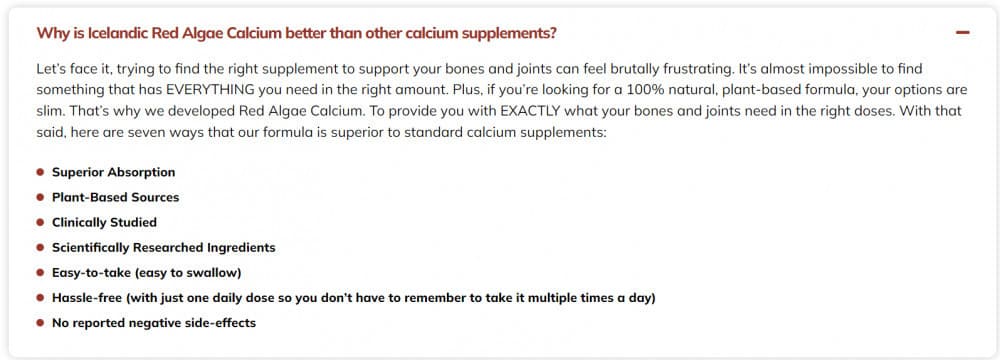
Its main attraction is the combination of red algae-derived calcium and magnesium with Vitamin D3, Vitamin K2 and additional plant compounds.
For someone specifically looking for a more comprehensive mineral and bone-support formula, I can see the appeal.
I’m considerably less convinced by the idea of buying it purely as a treatment for joint pain.
The research into red algae and osteoarthritis is interesting, but it’s still preliminary. I’d therefore look at the potential joint benefits as an added reason to be interested rather than a guarantee that your pain will disappear.
Overall, I still like the formula, but I’d keep your expectations realistic in terms of results.
Is Icelandic Red Algae Safe?
For most healthy adults, red algae-derived mineral supplements are likely to be well tolerated when taken according to the manufacturer’s directions.
However, that doesn’t mean more is always better.
Remember that these supplements can provide a significant amount of calcium, and you need to consider how much you’re already getting through your diet and other supplements.
Here in the UK, the NHS recommends that adults get around 700 mg of calcium per day, and most people should be able to obtain what they need from a varied diet.
Calcium supplements can also interact with certain medications, including some antibiotics and thyroid medications.
For this reason, I’d speak to your doctor or pharmacist before taking a red algae mineral supplement if you take regular medication, have kidney problems, have previously experienced kidney stones, or have been advised to monitor your calcium intake.
And, as mentioned earlier, don’t assume that every seaweed-derived supplement contains the same amount of iodine.
Always check the label.
People with thyroid conditions should be particularly careful about deliberately increasing their iodine intake without professional advice.

Related FAQs
What Is Icelandic Red Algae?
Icelandic red algae refers to species of red marine algae found in the waters surrounding Iceland and other parts of the North Atlantic.
Some calcified red algae naturally accumulate calcium, magnesium and numerous trace minerals from seawater. These mineral-rich algae can then be harvested and processed for use in dietary supplements.
Is Icelandic Red Algae Good for Joint Pain?
There is some early research suggesting that multimineral ingredients derived from red algae may help certain measures of mobility and joint function in people with knee osteoarthritis.
However, the studies we’ve looked at have generally been small.
I therefore wouldn’t describe Icelandic red algae as a proven treatment for joint pain.
Its mineral content and potential effects on joint health make it interesting, but considerably more research is needed.
Is Red Algae Good for Your Bones?
This is probably where red algae supplements make the most sense.
Calcified red algae can provide calcium and magnesium, both of which contribute to the maintenance of normal bones.
Some supplements also add Vitamin D and Vitamin K, giving you a broader bone-support formula.
Is Red Algae Calcium Better Than Regular Calcium?
Not necessarily.
Red algae-derived calcium has attracted interest because it comes as part of a naturally occurring multimineral complex rather than providing calcium completely on its own.
However, this doesn’t mean every red algae supplement is automatically better absorbed or more effective than conventional calcium supplements.
I’d look at the actual calcium dose, other minerals, supporting ingredients, quality testing and price before deciding which is better for you.
Does Icelandic Red Algae Contain Magnesium?
Calcified red algae can naturally contain magnesium alongside calcium and other trace minerals.
The amount varies between ingredients and finished supplements, however, so check the label if magnesium intake is one of your main reasons for buying the product.
Does Red Algae Contain Iodine?
Seaweed can be a source of iodine, but the amount varies considerably between different species and products.
For this reason, don’t assume a red algae calcium supplement contains a meaningful amount of iodine unless the manufacturer actually lists it.
This is particularly important if you have a thyroid condition or have been advised to monitor your iodine intake.
Can You Take Red Algae Calcium With Vitamin D?
Vitamin D is commonly combined with calcium because it contributes to normal calcium absorption and the maintenance of normal bones.
In fact, some red algae calcium supplements already contain Vitamin D.
Check your supplement label before adding additional Vitamin D so you know how much you’re getting from all sources.
Can You Take Icelandic Red Algae With Turmeric or Glucosamine?
These ingredients are sometimes used for different reasons, so there isn’t necessarily a direct choice between them.
Red algae is primarily interesting as a source of minerals, whereas curcumin from turmeric has been studied for inflammation and glucosamine has been studied in relation to osteoarthritis and joint function.
However, combining several supplements increases the importance of checking the ingredients and doses, particularly if you take medication or have an existing medical condition.
How Long Does Icelandic Red Algae Take to Work?
I wouldn’t put a specific number of days on this.
Some supplement companies may advertise noticeable results within a particular timeframe, but joint pain has many possible causes and people can respond very differently.
Minerals such as calcium and magnesium are nutrients the body requires continuously rather than fast-acting painkillers.
If you’re experiencing persistent or worsening joint pain, finding out what’s causing it is more important than waiting for a supplement to start working.
Final Thoughts – Is Icelandic Red Algae Worth Trying?
When I originally wrote this article, I was probably a little too enthusiastic about Icelandic red algae as a potential treatment for joint pain.
Having taken another look at the research, I think the reality is more interesting — but also more nuanced.
Red algae isn’t a miracle cure for arthritis.
What it does offer is a naturally occurring source of calcium, magnesium and various trace minerals, and there is some preliminary human research investigating red algae-derived multimineral ingredients for osteoarthritis and joint function.
I find that genuinely interesting.
For me, though, the strongest reason to consider a red algae supplement is its potential as part of a broader approach to bone and mineral support.
If you’re specifically looking for a supplement in this category, products such as GenF20 Red Algae Calcium are interesting because they combine red algae-derived minerals with nutrients including Vitamin D3 and Vitamin K2.
Whether you actually need a supplement is another question.
A balanced diet, regular exercise, maintaining a healthy weight and getting enough of the nutrients your bones need are all important. And if you’re dealing with persistent joint pain, I’d always put finding out the underlying cause ahead of simply trying supplement after supplement.
Still, Icelandic red algae is certainly an ingredient I’ll continue keeping an eye on.
The early research is promising enough to make it worth watching — I just wouldn’t make the mistake of turning “promising” into “proven.”
Have you tried Icelandic red algae, Aquamin or another supplement for joint health?
If so, I’d be interested to hear about your experience in the comments below.
Many thanks for reading.
#StayDynamic
Alex
DynamicIdeas4Life.com
Buy Red Algae Calcium Here: https://www.redalgaecalcium.com/ct/612991






Fix Your Energy, Sleep and Nutrition Today 🛠
Get our 20-Step Healthy Living eBook, Daily Health Planner and our other bonuses sent to your inbox instantly. Start your journey with 7 days of exclusive gifts and expert tips to stay fit throughout 2026.
Disclaimer: We hate spam too. Unsubscribe anytime.
Anxiety and Depression are you magnesium deficient BiOptimizers blood pressure supplements blood sugar control blood sugar support supplements digestive enzymes Digestive Enzymes Supplement Digestive Health digital products Dr Sam Robbins Gut Health Gut Health While Travelling Health Tips for Travelling Healthy Living heart health HFL hypomagnesia insulin resistance joint health supplement keto dieting Keto Diet Weight Loss leaky gut supplements list Low Stomach Acid magnesium Magnesium deficiency Matt Gallant mental health multivitamins Nootopia Nootropics Probiotics Probiotic Supplements reverse type 2 diabetes stress and anxiety stress relief Supplements vitapost Wade Lightheart weight loss articles weight loss diet plans weight loss product reviews weight loss supplements weight loss tea
About Author





Hi Alex,
This review of Icelandic red algae is very in-depth and answers a lot of “need to know questions”. Thank you! Iceland is well known to be one of the healthiest countries in the world possibly because of its mineral-rich volcanic soil and fish, I am quite interested in learning other reasons for the healthy lives of its people.
The GenF20 Red Algae Calcium supplement consists of several already well known nutrients. The uniqueness of this product seems to be the Icelandic Red Algae Calcium and a form of Vitamin D3. The calcium is a plant-based form that is much easier for the body to break down and absorb. This is important because with aging, calcium becomes much more slower and difficult to absorb resulting in brittle bones and possibility of inflammation and fractures from falls. I think that this is an important finding. Increased awareness and use will increase the number of reviews….
Thanks, Ceci
Thanks, Ceci, Think I covered most things in this article. There are maybe one or two more points I think I could look at further regarding this but anyhow yes Iceland is quite a fascinating place. I remember seeing something years ago about how their vegetables were especially nutritious because of the volcanic soil and that this was believed to be why they live such long lives. I mean besides this their mineral-rich sea and water possibly their culture could contribute to better health as well but I never really looked at this when doing this research although I maybe should have.
The GenF20 Red Algae Calcium supplement is an interesting one – its uniqueness I would say is from the PB Calcium and PB Magnesium as well as other trace minerals inside. The type of Vitamin D3 i’m not sure about if it is much different than that found in other supplements but the Vitamin K2 is a patented type so that is interesting. I will need to study this more I think but you are quite right it is important to strengthen your bones to prevent things like fractures and inflammation is not good either.
Hi Alex,
There is a ton of information in this article! I have never heard of Icelandic Red Algae before or its uses and found the information very interesting. I do not have joint pain, but my mother has suffered for years from joint pain and inflammation. If the product works it would really be beneficial. I am also intrigued by your statement that Icelandic people are healthier and that calcium that is plant-based is best. I have to take calcium daily and may have to look into that a bit more.
Thanks for the info,
Chastity
Hi Chastity, Yes I have written a few different articles about joint pain so knew a bit about this prior to this. It’s definitely something I need to continue my research into but anyhow my mother is the same. I want her to try something like this or maybe organic turmeric although I think a lot of her joint pain is down to wear and tear. She would need something I think that can help repair her cartilage and joints as well as relieve inflammation. I am thinking about getting her this but I wonder if she would also need something extra to help relieve any inflammation. Maybe something like Turmeric3D – anyhow yes Plant Based on Calcium I am thinking about trying myself. Drinking cow’s milk all the time although it is a source of Calcium – animal proteins inside can actually leach calcium from the bones also for the gut the casein proteins within milk are very hard to digest (much like gluten) so I wonder about supplementing with PB Calcium and Vitamin D3 for a while so I can give up drinking milk. Just to see how it affects my gut health.
Many people are looking for natural remedies for pain relief, and this looks like a great natural option. It would be good to see how this goes in regards to the studies…
There are many benefits from the diets that Icelandic people follow…
Thanks John yes this might be an idea for updating the article. I definitely shared some sources throughout but yes I see what you mean.
Wait, does the article actually mention specific strains or studies, or is it just general hype? Seems like a lot of people are claiming it works but I haven’t seen any solid proof.
Some time since I published this article. Actually not even sure if this product I reviewed is still available for sale but actually this whole thing about Icelandic Red Algae this is something to take a good look at. It is to do with the volcano deposits they make the algae in the water very rich in minerals. Actually, a lot of sea weed and vegetation has a lot of good nutritional benefits but this type in particular is a lot more mineral rich. If you look at the life expectancy here – the Icelandic are very healthy people that live very long lives.